boundary
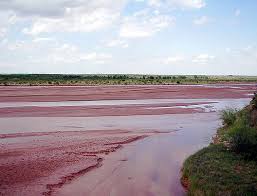
Although the Red River is not considered one of the major rivers of the world, nor of the United States, it has played a crucial role in the history of the region. The Red River begins as creeks in New Mexico that flow through Palo Duro (Spanish for “hardwood” for the hardwood shrubs and trees) Canyon, just south of Amarillo, Texas. It then forms the boundary between Oklahoma and Texas. From there it bends down through the southwest corner of Arkansas, into Louisiana and then empties into the Mississippi.
The Red River is called “red” due to the color of the water running through the red dirt of the region. The tribes, whether native to the area or relocated there, considered the place sacred, seeing the color of the earth symbolic of their own blood in the land.
“Oklahoma” is a Choctaw word meaning “home of the red people.” The territory was given to them, along with the Cherokee, the Creek, the Seminole, and the Chickasaw in exchange for the tribes’ ancestral lands east of the Mississippi in the Indian Removal Act, signed by President Andrew Jackson in 1830. In 1834 Oklahoma was officially set aside as Indian Territory in the newest of the statutes of the Indian (Non)Intercourse Act. In 1866, after the Civil War, the United States required new treaties from the tribes that had supported the Confederacy, pushing them into further land concessions.
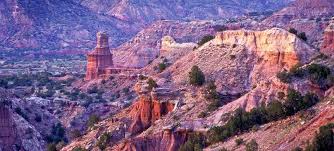
For decades the Comanches raided across Texas. Settlers of the plains dreaded the marauding bands, and the general consensus in the state was that all the Indians had to be forced out of Texas. Master horsemen, later called “lords of the plains,” the Comanches could outride almost any pursuer. They were able to further frustrate the pursuit of the Texas rangers due to their hidden encampment in Palo Duro Canyon. Second in size only to the Grand Canyon, it was a place that seemed to just suddenly drop into the ground. For a very long time, no one knew they were there, so they could live with their families in relative peace. Several other tribes camped there with them, as well, including the Southern Cheyenne, the Kiowa, and the Arapaho.
Fort Sill was established during in the Indian Wars in 1869 by Major General Philip H. Sheridan to stop hostile tribes from raiding border settlements in Texas and Kansas. During the Red River War, on September 28, 1874, several Army regiments under the command of Colonel Ranald S. MacKenzie attacked and defeated the encampment at Palo Duro Canyon. In June of 1875 the Red River War ended when Quanah Parker and his Quahadi band of Comanche surrendered at Fort Sill.
Thus ended the free-ranging nomadic lives of the captured tribes of the southern plains. They then had to learn to make new sedentary lives for themselves in Oklahoma. Quanah Parker was one of the leaders that went to great lengths to adapt and to lead his people in a new way.
It is known that the treaties of the American government with the Native Americans have been violated, bent, and broken time and again. When Tecumseh (1768-1813) dialogued with William Henry Harrison, he listed every violated treaty from the time of Massasoit (contemporary with the pilgrims) to his own. The six statutes of the Indian Nonintercourse Act were passed by Congress in 1790, 1793, 1796, 1799, 1802, and 1834 to protect the lands allotted to native tribes. The original was signed by President George Washington. The intentions may have been noble, but each time a new situation arose, the native peoples were again pushed to yet another place that was promised “as long as the grass grows and the waters flow.” Throughout the land, over a period literally spanning centuries, the aboriginal peoples have been forcibly pushed from their ancestral homes. They have been killed, abused, and enslaved. Their children have been taken from them and subjected to a policy that sought to totally eradicate their culture and language. This is nothing short of genocide—literal and cultural—and sadly, with the sanction of the very leadership that had officially promised these wards of the state its protection.
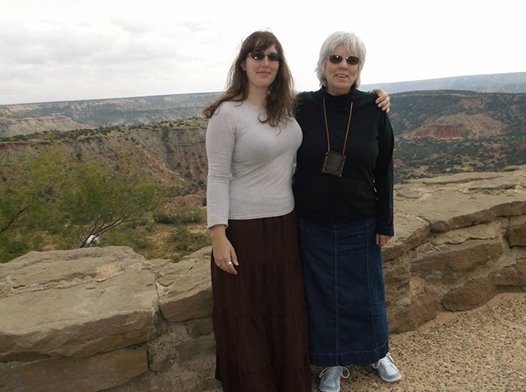
In 2013 I went camping in Palo Duro Canyon with friends—Shira and Ed. (Ed took the picture.) We wanted to get as close as possible to the source of the Red River at the Prairie Dog Town creek. Shira played her native flute. We meditated on the history of the area and prayed for the peace and blessing of the descendants of those tribal peoples. Shira had painted “sason v’simcha” (joy and gladness) on river rocks; we threw these into the water and prayed healing sason v’simcha for the people of all the lands the river touches.
The Torah says the blood of Abel, the very first murder victim, cried up to Hashem from the ground. May the blood crying from this land be consoled. May we all come to repentance and forgiveness for the hatred and bloodshed on both sides. May the land itself be healed and be permeated with true peace.
_________________________________
You can discover more about the healing vibration of “sason v’simcha” in my book:
Project Otiyot
by Miriam Leah Ben-Yaacov
Available at amazon.com
 Healing Well of Miriam
Leave a comment