I have been asked why I went to India—twice, in fact, in 2001 and 2002. Of course, before I went, I thought I had a pretty good idea of my reasons. I had divorced the year before, but although I was living a happy life in Israel, there were some things I needed to discover about myself and life in general. We lived in a community on the mountains over Jericho, where the Palestinian Authority headquartered and trained their police force. To qualify, it seemed a person had to have proven himself in the dubious art of terrorism. On that mountain overlooking Jericho, I prayed often about why we were all immersed in this state of violence, only be worsening, while being labelled “peace.” What was so broken in them to hate us so much; what was so broken in us to merit that hatred?
I traveled to various places in India: Delhi, Kashmir, Ladakh, Dharmsala, Rishikesh, and other towns and villages. Each place had its own stories of struggles between people. There was a great struggle of the Indian people against the rule of the British, however, British influence is undeniably stamped on India. There has been an ongoing struggle between Hindus and Moslems. In fact, a young Hindu man said to me that while he understood how I might disagree, he felt his people has suffered more from the Moslems than Israel has. There has also been a long history of separation of the castes. Although, from the time of Gandhi and the early days of independence, that system has been officially abolished, it is still alive in the minds and attitudes of Indian society.
Each place I visited evoked questions within me about relationships between people and about my own attitudes toward “the other.” In Dharmsala I heard that the Dali Lama had once said: “The poor Chinese and the terrible karma they are bringing on themselves by killing my people.” Rather than an answer for me, this brought me to yet another piece in the very confusing puzzle. Indeed, there has been conversation among the Tibetans about the value of passive resistance as opposed to an aggressive one.
Along the journey I heard a story I had always thought was simply a myth, of people hundreds of years old living in caves high in the Himalayas. The way it was told to my traveling companion, it sounds like something much more real. When he asked if I wanted to go to the places he had been told to look, I readily agreed. (Later, when I returned to Israel, I heard the story of someone who had actually found these people. I asked the rabbi who told me the story how it’s possible; he answered that we have had our own cave sitters—it just didn’t take them so long to “get it.”) Along the trail my companion asked me if I thought these people were just Hindus, like the ones we had encountered along the way. I had thought so, initially, but there was some other component to this story. He suggested that these people had found a way of “transcending religion and going straight into God.” That phrase resonated as a key truth—what each of us ultimately seeks from the depths of our souls. I had met the Bnai Noah who came to Israel with Vendyl Jones, and THIS seemed to be the very thing that defined their quest—AND the opportunity of this new consciousness in the world.
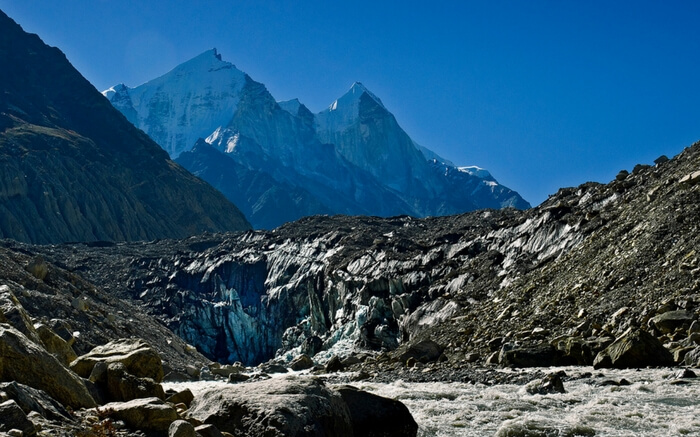
The Hindus say that if a person makes the journey to the four heads of the Ganges, he never has to reincarnate into this world. One of the most popular destinations is the glacier called Gaumukh, located above the small town of Gangotri, in the Uttarkashi District of the state of Uttarakhand, a far northern region bordering Tibet. The glacier is said to be the crouching cow of Shiva. Gaumukh, “mouth of the cow,” is one of the primary sources of the Ganges, as the water pours out of the bottom of the glacier, forming a river that furiously falls at Gangotri and then continues its rush down the mountain. On our trip we met only a few tourists, among them a number of Israelis; the majority were Hindus on pilgrimage. A Hindu temple sits beside the river in Gangotri; the priests there offer to perform pujas for the visitors. During our conversation with a young Hindu man in our guest house, I asked him if he had made the journey to perform a puja. He laughed “no” in such a way that hinted a distaste for such rituals of the religion. He said he was looking for “the one who would bring back the ancient knowledge,” not just for his people, but for all the world. This messianic idea made me think of the sons of Keturah sent east with the wisdoms of Abraham. Later, on the actual trek up the mountain, we met a group of young professional Indian men who expressed a similar attitude toward their own religion, and while they did not voice the hope he had, there was an unmistakable desire for a change that would improve the daily lives of the people of India.
On the way down from Gangotri, I watched the roaring stream. Here the Ganga is the mighty young man; below in the plain he becomes the lazy old man. I realized the importance of the sources of the rivers. Just as Adam was placed at the headwaters to pray for the garden (the world), the headwaters are the source of the rivers’ waters. It is the perfect place for pray, for the water carries information from the source to all below. It is a place of newness, of renewal, of receiving fresh insight from the spiritual headwaters. This is something the ancients must have known, intuitively inherited from Adam haRishon. So, we went to the source of the Ganges, an ancient Hindu holy site, yet a place where all was new; and there we saw the possibility of transcending religions of Man—religions that have brought division and strife between Mankind. We also witnessed others getting that same message—an inkling of hope that we call Redemption.
Unto Thousands of Generations
 Healing Well of Miriam
Leave a comment